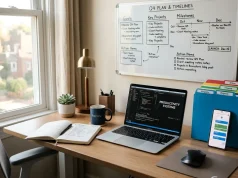
Struggling to balance classes, assignments, and personal life? Discovering the best student productivity tips transforms overwhelming academic pressure into manageable, daily achievements that boost your focus and efficiency.
This comprehensive guide reveals actionable student productivity tips to optimize your study sessions. You will learn proven time-management frameworks, workspace organization strategies, and digital tools designed to eliminate distractions, enhance your academic performance, and help you regain control over your busy schedule.
Why You Need Effective Student Productivity Tips Now

Every academic year brings harder classes, tighter deadlines, and rising expectations. Most learners rely on motivation or last-minute panic to finish their assignments. Relying on adrenaline leads to burnout, anxiety, and subpar grades. Implementing proven student productivity tips allows you to work smarter, not harder. By structuring your approach to learning, you build a sustainable routine that yields higher grades and leaves plenty of room for your personal life.
Learning how to study effectively requires intentional practice. The best student productivity tips focus on aligning your daily habits with your long-term academic goals. When you harness these strategies, you stop reacting to looming deadlines and start proactively managing your coursework. This proactive mindset separates top-performing scholars from those who constantly struggle to keep their heads above water. Building these habits now also prepares you for the demanding professional environments you will face after graduation.
The Difference Between Busy Work and Meaningful Progress
Many learners confuse sitting at a desk for hours with actual studying. Highlighting textbooks, re-reading notes without testing yourself, or endlessly organizing your digital folders often acts as an illusion of work. True productivity requires you to focus on high-impact tasks that directly improve your understanding and retention of the material.
To maximize your academic potential, you must eliminate busy work and prioritize active recall, practice testing, and deep focused reading. When applying student productivity tips, always ask yourself if the task at hand actively moves you closer to mastering the subject. If you spend three hours making flashcards but zero hours actually memorizing them, your efficiency drops to zero. You must implement robust goal setting frameworks to ensure your daily activities align with actual learning outcomes.
Mini-Conclusion: Distinguishing between passive busy work and active learning forms the foundation of academic success. By adopting effective student productivity tips, you shift your focus toward high-value activities that guarantee better grades and deeper comprehension.
Core Student Productivity Tips for Daily Success
Mastering your daily schedule requires systematic approaches to time and energy management. The most successful learners do not possess superhuman intelligence; they simply utilize superior strategies to manage their workload. Let us explore the fundamental student productivity tips that will revolutionize your daily routine.
Time Blocking and the Pomodoro Technique
Time management dictates your academic trajectory. One of the most powerful student productivity tips involves time blocking. Instead of working from a chaotic to-do list, assign specific blocks of time to specific subjects on your calendar. Treat these blocks like non-negotiable appointments. If you schedule a calculus study block from 2:00 PM to 3:30 PM, you do nothing but calculus during that window.
Combine time blocking with the Pomodoro Technique for maximum effectiveness. This method involves studying intensely for 25 minutes, followed by a 5-minute break. After four cycles, you take a longer 15-to-30-minute break. This rhythm prevents cognitive fatigue and keeps your brain fresh.
- Step 1: Choose a specific assignment or reading chapter.
- Step 2: Set a timer for 25 minutes.
- Step 3: Work with zero distractions until the timer rings.
- Step 4: Step away from your desk for a 5-minute break.
- Step 5: Repeat the cycle.
According to research by the American Psychological Association, taking structured breaks significantly improves focus and information retention. Integrating this rhythm into your daily schedule ranks among the most reliable student productivity tips available.
Strategic Goal Setting and Prioritization
You cannot hit a target you cannot see. Strategic goal setting prevents you from wandering aimlessly through your semester. Start each week by defining three to five major academic objectives. Break these large goals down into daily, bite-sized tasks.
Use the Eisenhower Matrix to prioritize your workload. This framework categorizes tasks into four quadrants based on urgency and importance. Focus your peak energy hours on tasks that are important but not necessarily urgent, such as researching a term paper due next month. Handling important tasks before they become emergencies drastically reduces your stress levels. Exploring various time management strategies will help you perfect your prioritization skills.
Comparison Table: Time Management Methods
|
Method |
Best Used For |
Core Benefit |
Potential Drawback |
|---|---|---|---|
|
Pomodoro Technique |
Reading, memorization, daily homework |
Prevents burnout, maintains high focus |
Can interrupt deep flow states |
|
Time Blocking |
Weekly planning, balancing multiple classes |
Creates structure, guarantees time for priorities |
Requires strict discipline to maintain |
|
Eisenhower Matrix |
Task prioritization, overwhelming to-do lists |
Clarifies what needs immediate attention |
Requires time to categorize tasks daily |
|
Eat the Frog |
Overcoming procrastination |
Builds immediate momentum in the morning |
Hard tasks can derail the entire morning if stuck |
Mini-Conclusion: Implementing structured time management frameworks transforms a chaotic syllabus into a manageable action plan. By utilizing time blocking and strategic prioritization, you execute these student productivity tips flawlessly to secure your academic goals.
Designing the Ultimate Study Environment

Your physical and digital environment directly influences your ability to focus. A cluttered, noisy workspace breeds a cluttered, distracted mind. One of the most critical student productivity tips is engineering an environment that actively pulls you into a state of deep focus.
Eliminating Digital Distractions
Your smartphone represents the greatest threat to your academic efficiency. Every notification, text message, or social media alert derails your attention. It takes the human brain over 20 minutes to fully refocus after a single interruption.
To protect your focus, you must implement aggressive digital boundaries. Put your phone on airplane mode or leave it in another room while studying. Install website blockers on your laptop to prevent mindless browsing. Treat your study sessions as sacred spaces where digital intrusions cannot reach you. By mastering your digital environment, you apply one of the most vital student productivity tips for modern learners.
Ergonomics and Physical Workspace
Studying on your bed signals to your brain that it is time to sleep, reducing your alertness and retention. You must designate a specific physical space solely for studying. Whether it is a library desk, a quiet coffee shop, or a dedicated desk in your dorm room, this space should train your brain to enter work mode automatically.
Ensure your workspace follows basic ergonomic principles. Position your monitor at eye level to prevent neck strain. Use a supportive chair that promotes good posture. Keep your desk clear of everything except the materials you immediately need. A clean, organized workspace drastically reduces cognitive load and anxiety.
Mini-Conclusion: Engineering a distraction-free, ergonomically sound environment significantly amplifies your ability to concentrate. Applying these environmental student productivity tips protects your focus and enhances your overall study efficiency.
Health and Wellness as Productivity Drivers
Many learners sacrifice their physical and mental health to study more hours. This approach severely backfires. Your brain requires proper fuel, rest, and recovery to absorb and process complex information. Neglecting your health destroys your cognitive capabilities. The most holistic student productivity tips emphasize intense self-care as the foundation of academic excellence.
The Power of Sleep
Pulling an all-nighter represents the worst possible strategy for test preparation. Sleep deprivation destroys your working memory, impairs your logical reasoning, and spikes your stress hormones. During deep sleep, your brain consolidates the information you learned during the day, moving it from short-term to long-term memory.
Aim for 7 to 9 hours of quality sleep every night. Establish a consistent sleep schedule, going to bed and waking up at the same time every day, even on weekends. Turn off all screens an hour before bed to allow your melatonin levels to rise naturally. Prioritizing sleep consistently ranks as one of the most powerful, yet overlooked, student productivity tips. The Centers for Disease Control and Prevention continuously highlights the direct link between adequate sleep and optimal cognitive performance.
Nutrition and Exercise
Your brain consumes roughly 20% of your body’s daily energy intake. Feeding it highly processed, sugar-heavy foods leads to massive energy crashes and brain fog. Focus on maintaining a balanced diet rich in complex carbohydrates, lean proteins, and healthy fats. Stay deeply hydrated; even mild dehydration causes a significant drop in concentration and analytical thinking.
Incorporate regular physical exercise into your weekly routine. Exercise increases blood flow to the brain, releases endorphins, and promotes the growth of new neural connections. You do not need to spend hours in the gym; a brisk 30-minute walk or a short yoga session can completely reset your focus. Leveraging these health-focused student productivity tips guarantees you have the stamina to survive rigorous academic terms. Connecting these physical habits with robust employee engagement surveys mental health frameworks often helps schools better support their student bodies.
Mini-Conclusion: Academic performance relies heavily on physical vitality. By prioritizing high-quality sleep, proper nutrition, and regular exercise, you build the cognitive endurance required to maximize these student productivity tips.
Advanced Student Productivity Tips and Tools

Technology, when used correctly, acts as a massive multiplier for your efficiency. Moving beyond physical planners and utilizing digital ecosystems allows you to organize your coursework, track your progress, and retrieve information instantly. Let us examine the advanced software and student productivity tips that top learners use to dominate their classes.
Digital Note-Taking Systems
Relying on loose sheets of paper practically guarantees you will lose important information before finals week. Transitioning to a digital note-taking system allows you to search, cross-reference, and organize your lectures flawlessly. Applications like Notion, Evernote, and Microsoft OneNote serve as secondary brains, holding all your syllabi, reading notes, and assignment drafts.
Use active note-taking frameworks like the Cornell Method. Divide your digital page into three sections: a narrow left column for cues and questions, a wide right column for general notes, and a bottom section for a brief summary. This method forces you to synthesize the material immediately, transforming passive listening into active learning. Mastering digital note-taking remains one of the most highly recommended student productivity tips for university-level coursework.
Task Management Applications
Keeping track of multiple group projects, midterms, and weekly homework requires a centralized command center. Task management tools like Todoist, Trello, or Asana allow you to visualize your entire semester.
- Create a separate project board for each class.
- Input every deadline from your syllabus during the first week of school.
- Break major essays down into smaller sub-tasks (e.g., research, outline, first draft, editing).
- Set digital reminders for three days before a major deadline.
These tools relieve your brain from the stress of remembering what is due. By outsourcing your schedule to a task manager, you free up mental bandwidth for actual problem-solving and critical thinking. Incorporating digital tools bridges the gap between basic habits and advanced student productivity tips.
Mini-Conclusion: Leveraging advanced digital tools transforms chaotic academic schedules into streamlined, manageable workflows. By adopting robust note-taking and task-management software, you implement modern student productivity tips that guarantee long-term organization and efficiency.
Common Mistakes to Avoid When Studying
Even highly motivated learners often fall into behavioral traps that sabotage their success. Recognizing and avoiding these pitfalls is just as important as implementing new student productivity tips.
The Multitasking Myth
Many people believe they can watch a lecture, check their email, and write an essay simultaneously. Neuroscience proves that true multitasking is a myth; you are actually switch-tasking, rapidly shifting your attention back and forth. This constant context switching depletes your mental energy and drastically increases your error rate. To harness true efficiency, you must focus entirely on one single task at a time. Single-tasking is the core philosophy behind all successful student productivity tips.
Passive Rereading and Highlighting
Reading a textbook chapter three times and highlighting half the page feels productive, but it results in very low information retention. This illusion of competence tricks you into thinking you know the material. Instead of passive rereading, use active recall. Close the book and force yourself to write down everything you remember. Practice testing yourself with flashcards. Active recall forces your brain to retrieve information, strengthening neural pathways and ensuring high performance on exam day. Avoiding passive learning completely elevates the effectiveness of your student productivity tips.
Mini-Conclusion: Eliminating toxic habits like multitasking and passive reading clears the path for genuine academic growth. Recognizing these common errors allows you to apply student productivity tips with maximum precision and effectiveness.
Pro Tips and Expert Insights on Academic Success
To truly excel, you must adopt the mindsets and strategies used by academic experts and productivity researchers. These advanced student productivity tips separate exceptional learners from the rest of the pack.
The Two-Minute Rule
If an academic or administrative task takes less than two minutes to complete, do it immediately. Replying to a professor’s email, organizing a digital folder, or printing out a reading assignment should never sit on a to-do list. Completing these tiny tasks instantly clears mental clutter and builds a continuous sense of momentum throughout your day.
Weekly System Reviews
Top performers do not just execute tasks; they constantly evaluate their own systems. Dedicate 30 minutes every Sunday evening to review your upcoming week. Assess which student productivity tips worked well for you and which ones failed. Did you stick to your time blocks? Did you get enough sleep? This weekly review allows you to recalibrate your strategy, ensuring you enter Monday morning with total clarity and a refined action plan. Institutions like Harvard University often advise their students to build robust weekly review habits to manage rigorous academic loads.
Mini-Conclusion: By adopting expert mindsets like the two-minute rule and committing to weekly system reviews, you continuously refine your approach to learning. These pro-level student productivity tips guarantee continuous improvement throughout your academic journey.
Conclusion
Mastering your academic workload requires intentional strategy and consistent execution. By embracing these powerful student productivity tips, you eliminate distractions, optimize your study environment, and build sustainable habits that drive long-term success. Take control of your schedule, implement these proven frameworks today, and start experiencing the academic excellence and personal freedom you truly deserve.
FAQs
1. What are the most effective student productivity tips for dealing with procrastination?
The most effective way to beat procrastination is breaking large, intimidating assignments into tiny, manageable steps. Use the Pomodoro Technique to commit to just 25 minutes of work. Often, simply starting the task eliminates the anxiety that causes procrastination in the first place.
2. How can I implement student productivity tips if I have a highly irregular class schedule?
If your schedule fluctuates daily, rely heavily on time blocking and a digital calendar. Map out your fixed classes first, then treat your empty gaps as non-negotiable study appointments. Flexibility is fine, but you must strictly block out study hours each week to maintain momentum.
3. Do these student productivity tips work for online or distance learning?
Yes, they are even more critical for online learning. Without the physical structure of a classroom, you must engineer your own study environment, eliminate digital distractions aggressively, and use task management software to keep track of your independent deadlines.
4. How many hours a day should I study to maximize student productivity tips?
Quality always trumps quantity. Four hours of highly focused, distraction-free studying using active recall is vastly superior to eight hours of passive, distracted reading. Aim for targeted, deep-work sessions rather than arbitrary hour counts to avoid burnout.
5. Why is sleep highlighted so heavily among student productivity tips?
Sleep is the biological mechanism your brain uses to consolidate memories and repair cognitive functions. Without adequate sleep, your ability to focus, solve complex problems, and retain new information plummets. Proper sleep makes every other productivity technique exponentially more effective.
6. What are the worst mistakes to make when applying student productivity tips?
The worst mistakes include attempting to multitask, relying on passive reading and highlighting, studying in a cluttered or distracting environment, and sacrificing sleep for late-night cramming. These toxic habits completely undermine your academic efficiency and lead to rapid exhaustion.
7. How do task management apps enhance student productivity tips?
Task management apps like Todoist or Asana act as an external brain. They centralize all your deadlines, break massive projects into sub-tasks, and send automated reminders. This relieves cognitive load, allowing your brain to focus on learning rather than worrying about forgotten assignments.
8. Can implementing student productivity tips improve my mental health?
Absolutely. The root cause of academic anxiety is often a feeling of losing control over looming deadlines. By using structured student productivity tips, you regain control of your schedule, drastically reducing stress and leaving intentional time for rest, hobbies, and socialization.
9. How do I maintain consistency with these student productivity tips throughout the entire semester?
Conduct a weekly review every Sunday to assess your habits. Give yourself grace when you slip up, but use the review to recalibrate for the week ahead. Focus on building one new habit at a time, such as mastering the Pomodoro Technique, before introducing complex digital task managers.
10. What is the Cornell Method and why is it recommended in student productivity tips?
The Cornell Method is an active note-taking system that divides your page into cues, notes, and a summary. It forces you to immediately synthesize and question the lecture material as you write it. This technique actively engages your brain, vastly improving your comprehension and long-term retention compared to traditional transcription.