Struggling to get things done? Discover effective beginner productivity tips to transform your daily routine, boost focus, and achieve your goals with less stress.
This comprehensive guide breaks down essential strategies for building better habits and managing your time. You will learn actionable frameworks, discover common pitfalls, and gain expert insights to optimize your daily workflow, reduce overwhelm, and create sustainable, long-term success.
Why Beginner Productivity Tips Matter for Your Daily Routine

Understanding how to manage your time effectively serves as the foundation for a balanced, low-stress lifestyle. When you first start exploring personal efficiency, the sheer volume of advice can feel overwhelming. Many people jump into complex systems, only to abandon them a week later. Starting with simple, foundational strategies allows you to build sustainable habits that actually stick.
Mastering the basics helps you reclaim hours of lost time each week. You stop reacting to emergencies and start proactively planning your days. This shift in mindset reduces anxiety and gives you the mental clarity needed to focus on high-impact tasks. Whether you want to excel at work, manage your household better, or simply find more time for hobbies, building a reliable system is your first step.
Small adjustments in your daily routine compound over time. By implementing a few core strategies, you train your brain to recognize cues and execute tasks with less friction. You will quickly notice improvements in your energy levels and your ability to stay focused during challenging projects.
Core Principles of Personal Efficiency
Before diving into specific techniques, you must understand the underlying principles of personal efficiency. These concepts dictate how you process information, make decisions, and allocate your physical and mental resources.
Conduct a Personal Time Audit
You cannot improve how you spend your time until you know where it currently goes. A time audit involves tracking every activity you do for a few days. You can use a notebook or a digital tracker to log your actions in 15-minute increments. This exercise reveals hidden time sinks, such as excessive social media scrolling or inefficient transitions between tasks.
Once you have your data, categorize your activities. Group them into essential tasks, meaningful leisure, and wasted time. This visual representation of your week provides a clear baseline. You can then identify specific areas where you can reclaim an hour or two each day.
Manage Your Energy, Not Just Your Time
Time management means little if you lack the energy to execute your plans. Your cognitive function fluctuates throughout the day based on your circadian rhythm. Some people feel most alert in the early morning, while others hit their stride in the late afternoon.
Identify your peak performance hours and fiercely protect them. Schedule your most demanding, complex tasks during these windows. Leave low-energy activities, like replying to emails or organizing files, for the periods when your focus naturally dips. Taking care of your physical health through adequate sleep, nutrition, and exercise directly impacts your daily output. You can find excellent resources on managing mental energy and well-being through Verywell Mind, which offers deep insights into psychological balance.
Essential Time Management Frameworks

Choosing the right framework gives structure to your workday. Different methods work for different personalities, so experiment with these foundational techniques to see which one aligns with your workflow.
The Pomodoro Technique
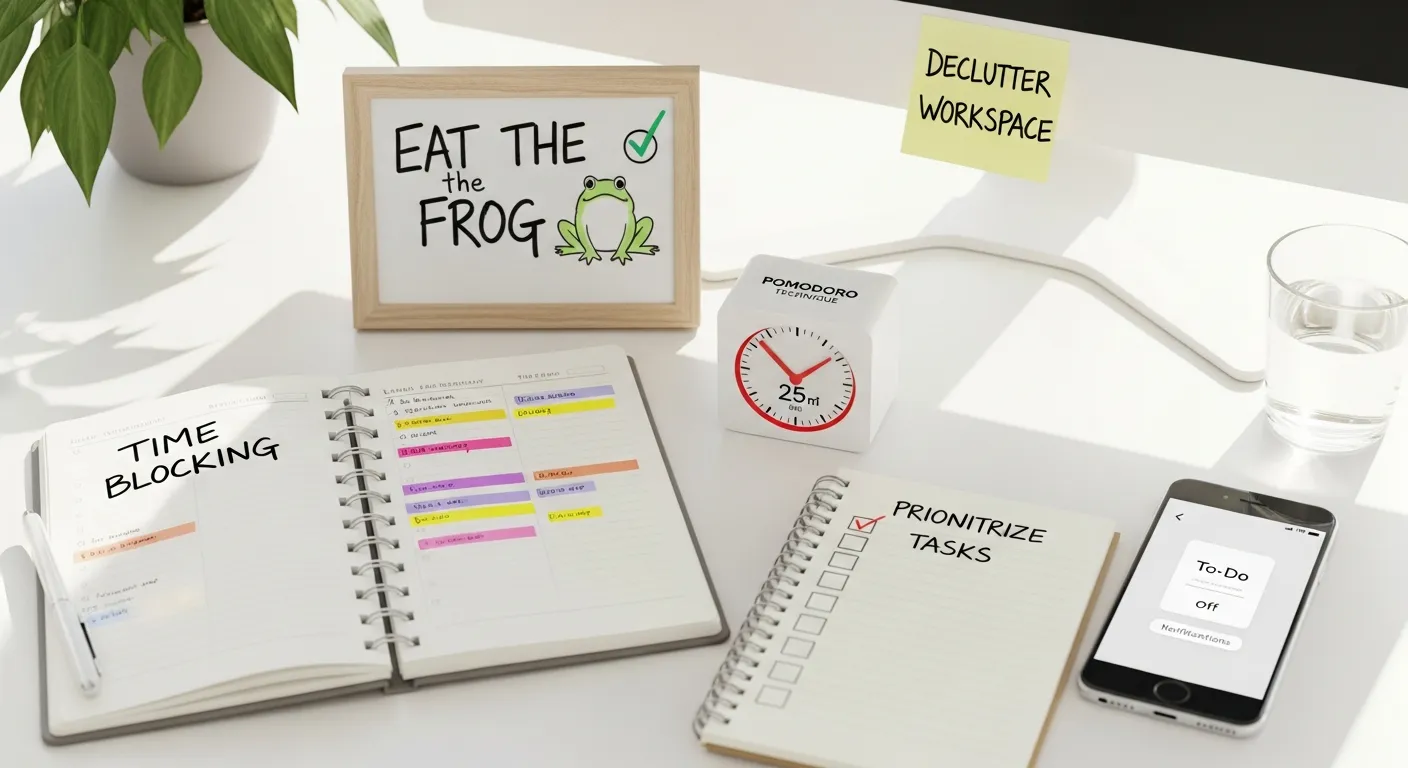
The Pomodoro Technique breaks your work into focused intervals, traditionally 25 minutes long, separated by short breaks. This method prevents burnout and keeps your mind fresh.
- Pick a single task to focus on.
- Set a timer for 25 minutes.
- Work continuously until the timer rings.
- Take a 5-minute break to stretch or grab a drink.
- After completing four cycles, take a longer break of 15 to 30 minutes.
This technique trains your brain to sustain focus for short bursts and prevents the fatigue associated with long, uninterrupted work sessions.
Time Blocking
Time blocking involves dividing your day into distinct blocks of time, dedicating each block to a specific task or category of tasks. Instead of working from an open-ended to-do list, you schedule your priorities directly onto your calendar.
Create specific blocks for deep work, meetings, administrative tasks, and personal downtime. When a block begins, you focus solely on that assigned category. This approach eliminates decision fatigue because you already know exactly what you should be doing at any given moment.
The Eisenhower Matrix
The Eisenhower Matrix helps you prioritize tasks based on their urgency and importance. You divide your tasks into four quadrants:
- Urgent and Important: Do these tasks immediately. They are critical deadlines or emergencies.
- Important, but Not Urgent: Schedule these tasks. They contribute to your long-term goals but do not require immediate action.
- Urgent, but Not Important: Delegate these tasks if possible. They demand attention but do not add significant value to your core objectives.
- Not Urgent and Not Important: Eliminate these tasks. They are distractions that drain your time.
Eat the Frog
Coined by Brian Tracy, this method requires you to tackle your most difficult, important task first thing in the morning. Your “frog” is the task you are most likely to procrastinate on.
By completing this critical item before anything else, you generate massive momentum for the rest of the day. You carry a sense of accomplishment that makes subsequent, smaller tasks feel effortless. You can read more about prioritization and task management strategies on Todoist’s Productivity Blog.
Framework Comparison Table
Here is a quick breakdown to help you choose the right framework for your needs:
|
Productivity Framework |
Best Used For |
Key Benefit |
Potential Drawback |
|---|---|---|---|
|
Pomodoro Technique |
Tasks requiring deep concentration |
Prevents mental fatigue |
Interrupts natural flow states |
|
Time Blocking |
Structuring chaotic, meeting-heavy days |
Eliminates decision fatigue |
Requires strict adherence |
|
Eisenhower Matrix |
Prioritizing massive to-do lists |
Clarifies true importance |
Can be tedious to update |
|
Eat the Frog |
Overcoming severe procrastination |
Builds early momentum |
Ignores low-energy mornings |
Step-by-Step Guide to Organizing Your Day
A productive day actually begins the night before. By designing a structured routine, you remove friction and make execution seamless.
Step 1: The Evening Shutdown Routine
Close out your current workday intentionally. Review what you accomplished and identify any open loops. Write down your top three priorities for the next day. By planning tomorrow today, you wake up with a clear action plan.
Prepare your physical environment. Clear your desk, pack your bag, or set out your clothes. Removing these small decisions from your morning frees up cognitive space for more important thinking.
Step 2: The Morning Launch
Start your morning proactively rather than reactively. Do not check your phone or email immediately upon waking. This instantly puts you in a state of reacting to other people’s demands.
Instead, spend the first hour on yourself. Hydrate, exercise, read, or meditate. Review the top three priorities you set the night before. Once you feel grounded and prepared, you can open your inbox and begin your workday on your own terms. We highly recommend looking into various habit tracking apps to monitor your morning routine consistency.
Step 3: Executing Deep Work
Allocate your highest energy hours to deep work. Turn off all notifications. Put your phone in another room or use website blockers to prevent digital distraction.
Work on one task at a time. Multitasking is a myth; your brain actually rapidly switches between tasks, which depleres your energy and increases errors. Focus entirely on the single objective in front of you until completion or until your scheduled block ends.
Step 4: Batching Shallow Work
Shallow work includes tasks that do not require intense cognitive effort, such as replying to emails, filling out forms, or scheduling appointments. Instead of letting these tasks interrupt your deep work, batch them together.
Set aside two specific times a day, perhaps late morning and late afternoon, to process all your shallow work at once. This keeps your inbox from dictating your schedule and protects your deep work intervals.
Digital vs. Physical Organization

A cluttered environment leads to a cluttered mind. Organizing your tools and workspace drastically reduces the friction of getting started.
Decluttering Your Digital Workspace
Your computer desktop and file system should support your workflow, not hinder it. Create a logical folder hierarchy so you can find documents instantly. Use cloud storage to ensure your files are accessible and backed up.
Audit your notifications. Turn off all non-essential alerts on your phone and computer. Every time a device buzzes, it breaks your concentration, and it takes an average of 23 minutes to regain deep focus.
Optimizing Your Physical Workspace
Your physical desk should only contain the items you need for your current task. Remove old coffee cups, scattered papers, and distracting gadgets. Ensure your chair provides adequate support and your monitor is at eye level to prevent physical strain. A clean, dedicated workspace signals to your brain that it is time to work. If you need help structuring your physical files, consider reading about daily planner templates to keep your notes organized.
Common Mistakes to Avoid When Building Habits
Many beginners fall into predictable traps that derail their progress. Recognizing these pitfalls helps you navigate around them.
- Relying on Motivation: Motivation is an emotion, and emotions fluctuate. Discipline and systems are reliable. Build habits so you act regardless of how you feel.
- The All-or-Nothing Mindset: If you miss one workout or fail to complete one time block, do not abandon the entire system. Give yourself grace and simply restart with the next task.
- Over-Scheduling: Do not pack every minute of your day. Tasks almost always take longer than expected. Leave buffer time between blocks to handle inevitable delays and emergencies.
- Ignoring Rest: Working non-stop leads to diminishing returns and eventual burnout. High-quality rest is just as important as high-quality work.
Pro Tips and Expert Insights for Sustained Focus
To truly master your output, you must look at how experts optimize their routines. James Clear, author of Atomic Habits, emphasizes the concept of the “Two-Minute Rule.” If a new habit takes less than two minutes to do, do it immediately. This helps overcome the initial resistance to starting. You can explore more of his behavioral insights at James Clear’s official website.
Another expert insight involves the “Zeigarnik Effect,” which dictates that people remember uncompleted or interrupted tasks better than completed tasks. This is why an unfinished to-do list keeps you awake at night. The solution is to write everything down. Transferring your tasks from your brain to paper closes the loop and reduces mental anxiety. You can find more practical life hacks and workflows over at Lifehacker, a prime resource for optimizing daily tasks.
The Role of Rest and Mental Well-being

You cannot hack your way out of a sleep deficit. Cognitive performance plummets when you are exhausted. Prioritize seven to eight hours of quality sleep every night.
Take actual breaks during your workday. Stepping away from your desk, taking a walk, or simply looking out the window gives your prefrontal cortex time to recover. Incorporate mindfulness practices into your routine to manage stress and maintain emotional equilibrium. A calm mind processes information faster and makes better decisions. Utilizing tools like time management tools can help you enforce these necessary breaks.
Conclusion
Mastering your daily workflow does not require superhuman discipline; it requires the right systems. By applying these beginner productivity tips, you can eliminate distractions, prioritize high-impact tasks, and reclaim your time. Start small, remain consistent, and protect your energy. Take action today by conducting a simple time audit and watch your efficiency transform.
FAQs
What is the easiest productivity method for a complete beginner?
The Pomodoro Technique is incredibly beginner-friendly. It only requires a timer and a task. By committing to just 25 minutes of work, you drastically reduce the intimidation factor of starting a large project, making it easy to build momentum.
How do I stop procrastinating on difficult tasks?
Use the “Eat the Frog” method. Identify the task you are dreading the most and complete it immediately upon starting your day. You can also break the task down into microscopic, highly manageable steps to reduce the friction of getting started.
Does multitasking actually work?
No, true multitasking is a myth for cognitive tasks. Your brain is simply task-switching rapidly, which drains mental energy, increases the likelihood of errors, and actually takes more time than doing tasks sequentially.
How much time should I leave for breaks?
You should take a 5-minute break for every 25 to 30 minutes of deep work, and a longer 15 to 30-minute break every two hours. Step away from screens during these breaks to allow your eyes and brain to truly rest.
What is a time audit and how do I do it?
A time audit is the process of tracking exactly how you spend your day. Keep a log for three days, writing down what you do every 15 to 30 minutes. This reveals your hidden time-wasters and helps you make informed adjustments to your schedule.
How can I maintain focus in a noisy environment?
Invest in noise-canceling headphones and listen to instrumental music, white noise, or binaural beats. Face away from high-traffic areas if possible, and communicate your deep work hours to the people around you.
Why do my to-do lists make me feel overwhelmed?
Your list is likely too long and lacks prioritization. Limit your daily to-do list to three to five essential items. Use the Eisenhower Matrix to separate truly important tasks from things that can wait or be delegated.
How do I recover after falling off my routine?
Do not panic or adopt an all-or-nothing mindset. Acknowledge the slip-up, forgive yourself, and focus entirely on executing the very next scheduled block or task. Consistency is about returning to the baseline quickly.
Is it better to use digital apps or a paper planner?
This depends entirely on your personal preference. Digital apps offer reminders, syncing, and easy editing, while paper planners provide tactile engagement and eliminate screen distractions. Use whichever tool you will actually look at every day.
How does sleep affect my daily output?
Sleep is the foundation of all cognitive function. A lack of sleep impairs memory, decision-making, and emotional regulation. Prioritizing seven to eight hours of sleep will do more for your output than any app or framework.