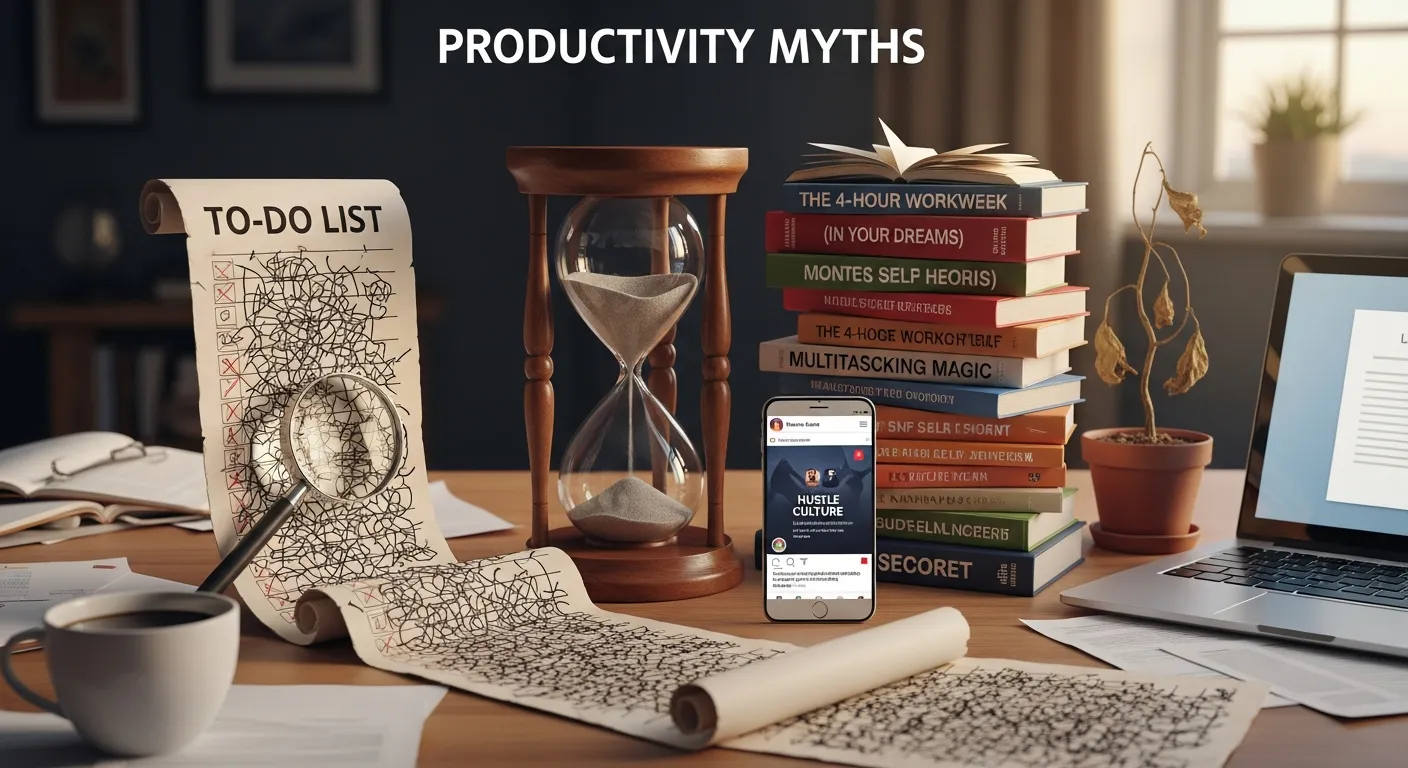
You want to get more done, but falling for common productivity myths actually ruins your output. Let us explore the real strategies that guarantee true efficiency and focus.
Many professionals struggle with burnout because they follow outdated advice. This guide exposes harmful productivity myths and provides actionable, science-backed frameworks. You will learn how to optimize your energy, eliminate distractions, and implement workflows that actually deliver measurable, sustainable results every single day.
The Danger of Believing Productivity Myths

We constantly hear that success requires relentless hustle. However, chasing harmful productivity myths destroys your focus and drains your mental reserves. When you base your daily routine on false assumptions, you waste precious hours fighting your natural rhythms. Understanding the difference between perceived busyness and actual output changes how you approach your daily tasks.
By dismantling these productivity myths, you free yourself from unrealistic expectations. You can finally adopt sustainable habits that protect your well-being while increasing your high-impact output.
Myth 1: Multitasking Helps You Accomplish More
We often think handling three tasks at once makes us highly efficient. This represents one of the most pervasive productivity myths in modern office culture.
The Reality of Context Switching
Your brain cannot process multiple high-level cognitive tasks simultaneously. Instead, it rapidly switches between contexts. This constant shifting creates a cognitive penalty. Research shows that context switching reduces your overall efficiency by up to 40 percent. You make more mistakes, retain less information, and exhaust your mental energy much faster than if you focused on a single project.
Step-by-Step Guidance to Single-Tasking
- Identify the priority: Pick the single most important task for your morning.
- Block your time: Allocate a specific 60-minute window solely for this task.
- Remove triggers: Close unnecessary browser tabs and put your phone in another room.
- Execute with focus: Work continuously until the timer goes off.
- Rest and reset: Take a five-minute break before starting the next task.
Common Mistakes to Avoid
- Keeping email notifications active while drafting a complex document.
- Believing that listening to a podcast while writing counts as effective multitasking.
- Failing to communicate your focused hours to your team.
Expert Tips
Use a time blocking strategy to give every hour of your day a specific job. When you dedicate specific blocks to specific tasks, you eliminate the urge to juggle.
Section Conclusion
Abandoning the multitasking illusion instantly improves your work quality. Single-tasking preserves your cognitive bandwidth, ensuring you finish tasks faster and with far fewer errors.
Myth 2: Waking Up at 5 AM Guarantees Success
Social media heavily promotes the idea that early risers naturally achieve more. This stands as one of the most exclusionary productivity myths.
Chronotypes and Natural Energy
Your biological clock, or chronotype, dictates your natural energy peaks. While some people naturally thrive at dawn, others hit their cognitive peak late in the afternoon or evening. Forcing a night owl to wake up at 5 AM usually results in sleep deprivation, which destroys focus and creativity. According to the National Sleep Foundation, getting seven to nine hours of quality sleep matters far more than the specific time your alarm goes off.
Step-by-Step Guidance to Finding Your Peak Hours
- Track your energy: Keep a log of your focus levels for one week.
- Identify patterns: Note when you feel most alert and when you experience a slump.
- Align your tasks: Schedule your hardest cognitive work during your peak hours.
- Protect your sleep: Set a consistent bedtime that guarantees eight hours of rest.
- Adjust your mornings: Create a morning routine that fits your natural wake time, whether that is 6 AM or 9 AM.
Common Mistakes to Avoid
- Sacrificing sleep hours just to join the “5 AM club.”
- Forcing highly analytical work during your natural biological dip.
- Relying on excessive caffeine to mask sleep deprivation.
Expert Tips
Leverage energy management techniques rather than strictly managing your time. Match your most demanding projects with your highest energy windows for maximum output.
Section Conclusion
Success comes from optimizing your unique biological rhythm, not forcing yourself into an arbitrary morning schedule. Prioritize adequate rest to maintain sharp focus throughout your workday.
Myth 3: Working Longer Hours Yields Better Results

Many corporate environments reward employees who stay late, falsely equating desk time with value. This ranks among the most damaging productivity myths for employee health.
The Law of Diminishing Returns
Working beyond a certain threshold drastically reduces your output quality. The human brain can only sustain deep focus for about four to five hours a day. Pushing beyond this limit leads to the law of diminishing returns. You start making errors that take twice as long to fix the next day. A study by Stanford University revealed that productivity plummets sharply after a 50-hour workweek.
Step-by-Step Guidance to Maximizing Work Hours
- Set strict boundaries: Determine an exact end time for your workday.
- Prioritize ruthlessly: Use the Eisenhower Matrix to separate urgent tasks from important ones.
- Work in sprints: Apply the Pomodoro technique (25 minutes of work, 5 minutes of rest).
- Log off completely: Disconnect from all work communication platforms when your day ends.
- Evaluate output, not hours: Measure your success by tasks completed, not time spent at the desk.
Common Mistakes to Avoid
- Believing that staying online until 8 PM proves your dedication.
- Filling extra hours with low-value administrative tasks.
- Skipping meals to power through a large project.
Expert Tips
Adopt a results-oriented work environment mindset. Focus purely on the value of the deliverables you produce rather than the clock.
Section Conclusion
Capping your work hours forces you to prioritize effectively. You will accomplish the tasks that actually move the needle and leave the trivial items behind.
Myth 4: Keeping a Massive To-Do List Keeps You Organized
Writing down fifty tasks for the day feels productive, but it actually fuels anxiety. Believing you must finish everything on a massive list is one of the most overwhelming productivity myths.
The Overwhelm of Choice
When you face a sprawling list of tasks, you experience choice paralysis. Your brain struggles to decide where to start, so it defaults to the easiest, least impactful items. You end the day having checked off twenty minor tasks while ignoring the one crucial project that actually mattered.
Comparison Table: Ineffective vs. Effective Task Lists
|
Feature |
Massive To-Do List |
Curated Daily List |
|---|---|---|
|
Task Count |
15+ items |
3-5 high-impact items |
|
Prioritization |
Random or chronological |
Ranked by impact and urgency |
|
Psychological Effect |
Overwhelming and stressful |
Focused and motivating |
|
End of Day Feeling |
Defeated (items left undone) |
Accomplished (core tasks finished) |
Step-by-Step Guidance to Curating Your List
- Brain dump: Write everything you need to do in a master backlog.
- Select the critical few: Pick only three to five essential tasks for today.
- Estimate time: Assign a realistic time duration to each chosen task.
- Sequence the work: Order the tasks logically, tackling the hardest one first.
- Move unfinished items: If a task remains incomplete, consciously move it back to the backlog.
Common Mistakes to Avoid
- Mixing huge projects (“Write annual report”) with tiny tasks (“Reply to John”) on the same list.
- Adding new tasks to your daily list as they pop up.
- Failing to break large projects down into actionable steps.
Expert Tips
Utilize agile task management principles. Keep a backlog of future tasks, but only pull a few into your active daily workflow to maintain high velocity.
Section Conclusion
A short, curated list creates immediate clarity. By focusing only on a few vital tasks, you guarantee progress on your most important goals every single day.
Myth 5: Taking Breaks Destroys Your Momentum
Some professionals feel guilty stepping away from their monitors. They view breaks as a weakness, buying into one of the most counterintuitive productivity myths.
The Neuroscience of Rest
Your brain consumes a massive amount of energy. Continuous focus depletes your cognitive resources, leading to decision fatigue and creative blocks. Stepping away allows your brain’s default mode network to activate. This network processes information in the background, which often leads to sudden insights and creative problem-solving. A brief walk or moments of quiet actually rebuild your momentum.
Step-by-Step Guidance to Effective Breaks
- Schedule downtime: Put 15-minute breaks on your calendar just like meetings.
- Step away: Physically leave your workspace during the break.
- Disconnect digitally: Do not look at your phone or read the news.
- Move your body: Stretch, walk outside, or grab a glass of water.
- Return with intent: Review your next task clearly before sitting back down.
Common Mistakes to Avoid
- Scrolling social media during a break (this still drains cognitive energy).
- Eating lunch while staring at a spreadsheet.
- Waiting until you feel completely exhausted before resting.
Expert Tips
Incorporate strategic rest protocols into your daily routine. Treat recovery as a mandatory component of high performance, exactly like an elite athlete does.
Section Conclusion
Strategic breaks act as an essential fuel for sustained focus. You will return to your desk sharper, faster, and ready to tackle complex challenges with renewed vigor.
Myth 6: Being Busy Equals Being Productive

We live in a culture that glorifies the hustle. However, equating constant motion with actual achievement represents one of the most deceptive productivity myths.
Activity vs. Accomplishment
You can spend eight hours replying to emails, attending status meetings, and organizing digital files. You feel exhausted by 5 PM, but you have produced zero tangible value. True productivity means executing tasks that align with your core objectives. Busywork creates the illusion of progress while keeping you stuck in a holding pattern.
Step-by-Step Guidance to Eliminating Busywork
- Define your goals: Write down your top three objectives for the quarter.
- Audit your schedule: Review last week’s calendar and categorize every activity.
- Identify the fluff: Highlight meetings and tasks that did not serve your core goals.
- Automate or delegate: Find software to handle repetitive tasks or pass them to others.
- Learn to say no: Politely decline meetings where your presence provides no direct value.
Common Mistakes to Avoid
- Saying yes to every request to appear helpful to colleagues.
- Confusing a full calendar with a successful workday.
- Obsessing over “inbox zero” instead of doing deep work.
Expert Tips
Conduct a weekly time audit review to ensure your daily actions directly support your long-term goals. Cut out the noise mercilessly.
Section Conclusion
Shift your focus from doing more things to doing the right things. Stripping away busywork leaves room for deep, meaningful work that drives actual success.
Myth 7: You Need the Perfect System to Start
Many people spend weeks testing new apps and color-coding planners before they actually do any work. Believing that software solves procrastination is one of the most common productivity myths.
The Procrastination Trap of Perfectionism
Endlessly tweaking your organizational system serves as a sophisticated form of procrastination. You feel like you are working because you are organizing, but you produce nothing. The best productivity system is the one you actually use consistently. Simple methods almost always outperform complex, highly fragile systems.
Step-by-Step Guidance to Starting Simple
- Pick one tool: Choose a basic notebook or a simple digital text document.
- Write the next step: Identify the very next physical action required to start your project.
- Execute immediately: Do that single action without organizing anything else.
- Build the habit: Stick with the simple tool for at least 21 days.
- Upgrade later: Only add complexity or new software if your simple system genuinely breaks down.
Common Mistakes to Avoid
- Migrating your tasks between five different apps in one month.
- Spending two hours designing a complex project board for a simple task.
- Waiting for the “perfect moment” to begin a difficult project.
Expert Tips
Embrace frictionless workflow design. Your system should require near-zero mental effort to maintain, allowing you to pour all your energy into the actual work.
Section Conclusion
Action beats perfection every time. Start messy, execute the work, and let your organizational system evolve naturally as your needs grow.
What Really Works: Core Principles of High Efficiency
Now that we have dismantled the most damaging productivity myths, we must focus on the proven strategies that actually enhance performance. Building a sustainable workflow requires intentionality, focus, and a deep understanding of your own work habits.
Master the Art of Deep Work
Coined by author Cal Newport, deep work involves focusing without distraction on a cognitively demanding task. This state of flow produces massive value in a fraction of the time required by distracted work. To cultivate deep work, you must ruthlessly eliminate interruptions. Turn off all notifications, communicate your focus hours to your team, and train your brain to handle longer periods of intense concentration.
Implement the Two-Minute Rule
If a task takes less than two minutes to complete, do it immediately. Do not schedule it, do not write it down, and do not save it for later. Replying to a quick question, approving a simple document, or paying a bill instantly clears mental clutter. This rule prevents tiny tasks from snowballing into massive, overwhelming lists.
Optimize Your Environment
Your physical workspace heavily influences your mental state. A cluttered desk creates visual noise that distracts your subconscious. Keep your primary workspace clean and minimalist. Ensure you have proper lighting, an ergonomic chair, and comfortable temperature control. When your environment supports focus, your brain naturally transitions into work mode faster.
Practice Asynchronous Communication
Constant instant messaging destroys deep work. Instead of expecting immediate replies, teams should adopt asynchronous communication. Write detailed, clear messages that colleagues can read and respond to when it suits their workflow. This approach respects everyone’s focus time and drastically reduces the anxiety of the modern workplace. Check out insights on effective remote work from Harvard Business Review for more on asynchronous strategies.
Embrace the Power of “No”
Every time you say yes to a non-essential request, you say no to your own priorities. High performers protect their time fiercely. Learn to decline requests politely but firmly. Offer alternative solutions or realistic timelines that do not compromise your core objectives. Protecting your calendar represents the highest form of professional self-care.
Summary of Effective Strategies
Dismantling productivity myths allows you to build a system that genuinely works. Stop multitasking, respect your natural energy cycles, limit your work hours, curate short task lists, take strategic breaks, eliminate busywork, and start with simple systems. When you apply these proven principles, you achieve more while preserving your mental health.
Conclusion
Clinging to outdated productivity myths only leads to burnout and frustration. True efficiency requires you to work with your natural rhythms, eliminate distractions, and focus relentlessly on high-impact tasks. By abandoning the hustle culture and embracing mindful, strategic work habits, you will accomplish your goals faster. Start applying these proven frameworks today and watch your output soar.
FAQs
1. What are the most common productivity myths in the workplace today?
The most prevalent productivity myths include the belief that multitasking increases output, working longer hours equals better results, and you must wake up at 5 AM to be successful. These myths ignore human biology and cognitive limits, often leading to severe burnout and decreased work quality over time.
2. Why does multitasking actually hurt my productivity?
Multitasking forces your brain to rapidly switch contexts between different activities. This switching creates a cognitive penalty, leading to a massive loss of focus. You end up making more errors, feeling more exhausted, and taking much longer to finish tasks compared to focusing on one thing at a time.
3. How can I stay productive without working 12-hour days?
Focus on working deeply rather than working long. Apply time-blocking strategies to handle your most critical tasks during your peak energy hours. By ruthlessly eliminating busywork, meetings without agendas, and digital distractions, you can accomplish more in six focused hours than in twelve distracted ones.
4. Do I really need to wake up at 5 AM to be highly productive?
No. The idea that early rising guarantees success is one of the most widespread productivity myths. Your productivity depends on your personal chronotype. If you naturally focus better in the late afternoon, tailor your schedule to tackle hard work then. Quality sleep matters far more than the time you wake up.
5. What is the difference between being busy and being productive?
Being busy means engaging in constant activity, such as replying to emails or attending low-value meetings, without producing meaningful results. Being productive means executing tasks that directly advance your core goals. Productivity focuses entirely on the value of the outcome, while busyness focuses only on motion.
6. How do breaks actually improve my daily output?
Your brain requires significant energy to maintain deep focus. Continuous work depletes this energy, causing decision fatigue. Taking structured breaks allows your brain to recover, process information, and generate creative solutions. You return to your tasks with renewed clarity, enabling you to work faster and more accurately.
7. Why do massive to-do lists make me procrastinate?
A long list of tasks triggers choice paralysis and anxiety. When faced with too many options, the brain tends to choose the easiest, least important tasks to get a quick dopamine hit. Curating a short list of three to five essential items removes this overwhelm and forces you to execute high-impact work.
8. What is the two-minute rule and how does it help?
The two-minute rule states that if an action takes less than two minutes to finish, you should do it immediately rather than writing it down or scheduling it. This simple habit prevents tiny administrative tasks from piling up and causing mental clutter, keeping your workflow smooth and efficient.
9. How does perfectionism act as a productivity myth?
Many believe they need a perfect organizational system or the perfect moment to start a project. This belief is a disguised form of procrastination. Spending hours tweaking a digital planner provides the illusion of work without yielding actual results. Starting with a simple system and taking immediate action always works better.
10. How can I measure my actual productivity instead of just hours worked?
Stop looking at the clock and start tracking your deliverables. Set clear, measurable goals for your week. If you complete your most critical, high-impact tasks by Wednesday, you have had a highly productive week, regardless of how many hours you sat at your desk. Focus on outcomes, not inputs.