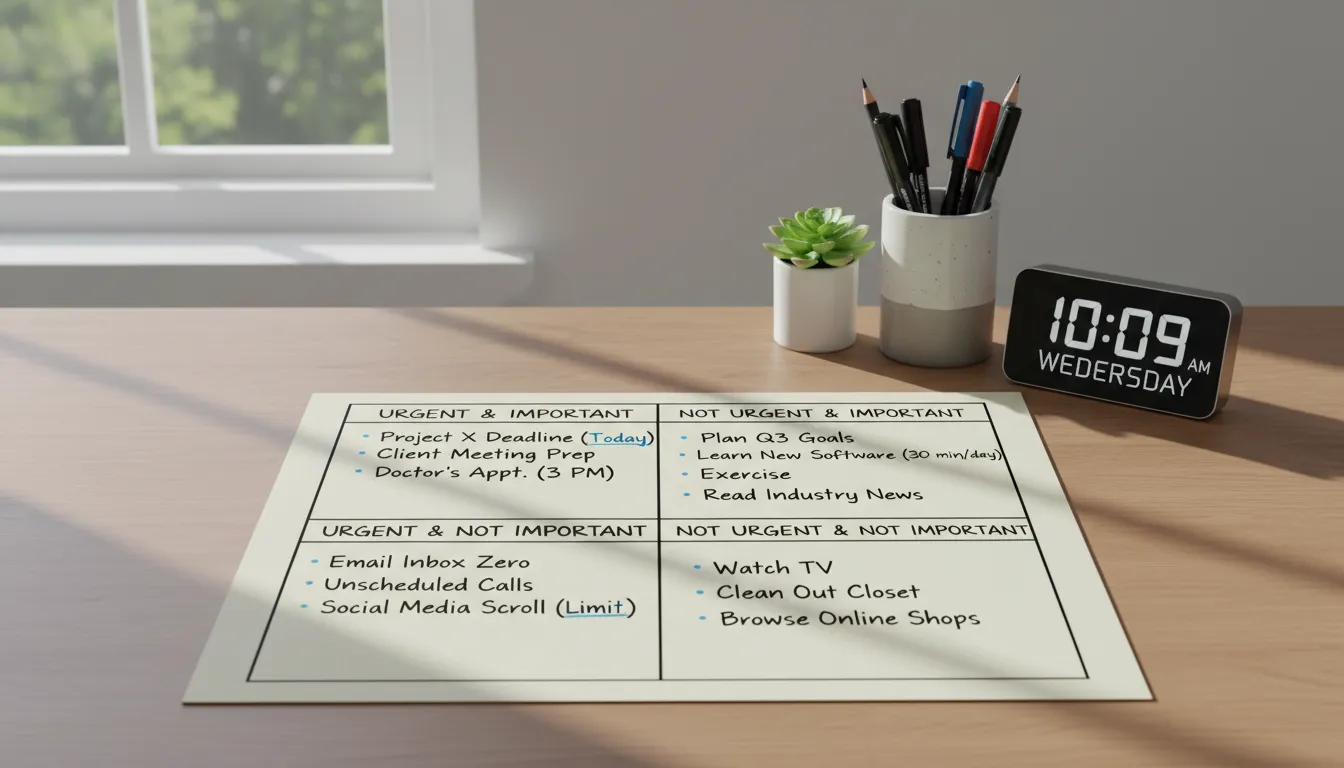
Feeling overwhelmed by endless tasks? A time management matrix provides the ultimate solution for this modern chaos. Discover how this powerful framework transforms education through calm and focused prioritization.
This comprehensive guide explores the four quadrants of effective task prioritization. You will learn actionable strategies to reduce stress, avoid burnout, and achieve academic excellence. Master your schedule by separating the truly important educational goals from distracting, urgent interruptions to foster deep, focused learning.
Understanding the time management matrix in Educational Settings

The modern educational landscape moves at a blistering pace. Students, teachers, and administrators constantly juggle a relentless influx of assignments, grading, meetings, and extracurricular responsibilities. In this high-stress environment, everything feels urgent, and crucial long-term goals often fall by the wayside. This is exactly where a time management matrix becomes an indispensable survival tool.
Originally popularized by Stephen Covey in his groundbreaking work on personal effectiveness, and heavily inspired by President Dwight D. Eisenhower’s decision-making framework, the time management matrix categorizes every task based on two critical metrics: urgency and importance. Urgency dictates how soon a task demands attention, while importance relates to how much a task contributes to your overall mission, values, and high-priority goals.
By utilizing a time management matrix, you stop merely reacting to whoever shouts the loudest or whatever deadline looms the closest. Instead, you develop a proactive mindset. For educators and students alike, adopting this matrix means intentionally designing your day to foster calm, focused learning environments. When you filter your academic and professional life through this simple four-quadrant system, you immediately illuminate the massive difference between simply being busy and being genuinely productive.
The Four Quadrants of Prioritization
To fully harness the power of a time management matrix, you must understand the unique psychology and function of its four distinct quadrants. Each quadrant represents a different state of mind and a different approach to your daily workload.
Quadrant 1: Urgent and Important (The Crisis Sector)
Tasks that land in the first quadrant of your time management matrix demand your immediate, undivided attention. These are the pressing deadlines, the sudden crises, and the unavoidable emergencies. In an educational context, this might look like a major term paper due at midnight, a parent-teacher conference concerning a behavioral emergency, or studying for a final exam happening the very next morning.
While you cannot completely eliminate Quadrant 1 tasks, living constantly in this space leads to severe burnout, anxiety, and a perpetual feeling of panic. The goal of a highly effective time management matrix is not to ignore these tasks, but to manage your life so efficiently that fewer tasks ever escalate to this critical, panic-inducing level.
Quadrant 2: Important but Not Urgent (The Strategy Sector)
Quadrant 2 is the beating heart of effective prioritization and the ultimate destination for anyone seeking to transform education through calm and focus. Tasks in this section of the time management matrix are deeply important to your long-term success but carry no immediate deadline. Because they do not scream for your attention, human nature often pushes them aside in favor of immediate distractions.
In the realm of education, Quadrant 2 includes deep reading, proactive lesson planning, engaging in meaningful professional development, building strong relationships with students, and dedicating time to physical and mental wellness. When you invest the majority of your time here, you actively prevent the crises of Quadrant 1. Focusing on this sector allows students to study incrementally over weeks rather than cramming overnight. It empowers teachers to design innovative, engaging curricula rather than throwing together rushed lesson plans at the last minute.
Quadrant 3: Urgent but Not Important (The Distraction Sector)
The third quadrant of the time management matrix acts as the great deceiver. These tasks present themselves as highly urgent, creating a false sense of necessity, but they contribute almost nothing to your actual educational goals. These interruptions usually stem from the priorities and poor planning of other people.
Examples of Quadrant 3 tasks include a constant barrage of low-priority emails, unannounced visitors dropping by a classroom or dorm room, or meetings that lack a clear agenda. To protect your calm and focus, you must aggressively delegate, automate, or decline these activities. Recognizing the deceptive nature of Quadrant 3 is a massive leap forward in mastering your time management matrix.
Quadrant 4: Not Urgent and Not Important (The Waste Sector)
The final quadrant in your time management matrix represents pure time-wasting activities. These tasks offer zero value to your academic journey or professional career and carry absolutely no urgency. We often retreat to Quadrant 4 when we feel exhausted from battling the crises of Quadrant 1.
Mindless scrolling on social media, binge-watching television shows when you should be resting or studying, and engaging in petty campus gossip all live in this sector. While human beings absolutely need true rest and leisure, Quadrant 4 activities do not provide genuine rejuvenation. A successful time management matrix helps you identify these behaviors so you can drastically minimize or eliminate them.
Transforming Education Through Calm and Focus

Implementing a time management matrix does much more than just organize a to-do list; it fundamentally shifts the culture of learning and teaching. When an entire classroom or administrative team adopts this framework, the educational environment transforms from a chaotic battleground into a sanctuary of focused academic pursuit.
Empowering Student Autonomy
Students often feel entirely at the mercy of their syllabi. By teaching students how to build their own time management matrix, educators hand the power back to the learner. A student who understands how to prioritize Quadrant 2 activities will naturally break down a massive semester-long project into small, manageable weekly tasks. This proactive behavior deeply enhances cognitive retention. According to research published by institutions like Harvard University, spaced repetition and low-stress study environments dramatically improve academic performance compared to high-stress, urgent cramming sessions.
When students operate from a place of calm, their anxiety plummets. They sleep better, participate more actively in discussions, and produce higher quality work. The time management matrix essentially functions as an anxiety-reduction tool, proving that academic rigor does not require academic suffering.
Elevating Instructional Quality
Teachers face some of the most demanding schedules of any profession. A teacher relying on a time management matrix can clearly separate the vital tasks of curriculum design and student mentorship from the noisy distractions of endless administrative paperwork.
By deliberately blocking out time for Quadrant 2 planning, educators create richer, more engaging lessons. They cultivate a classroom atmosphere rooted in deliberate focus rather than frantic rushing. This calm energy transfers directly to the students, creating a positive feedback loop of focused learning and mutual respect.
Step-by-Step Guide: Implementing the Framework
Understanding the theory behind the time management matrix means very little without concrete execution. Follow this detailed, step-by-step guide to seamlessly integrate this prioritization powerhouse into your daily educational routine.
Step 1: Conduct a Comprehensive Time Audit
Before you can organize your tasks, you must understand exactly how you currently spend your time. For three consecutive days, write down everything you do and how long it takes. Include everything from attending lectures and grading papers to scrolling through your phone. This audit will reveal uncomfortable but necessary truths about your current habits.
Step 2: Brainstorm and List Every Task
Empty your brain onto a piece of paper or a digital document. List every single assignment, chore, meeting, and goal weighing on your mind. Do not attempt to organize them yet. The simple act of writing everything down instantly reduces cognitive load and anxiety.
Step 3: Categorize Using the Matrix
Draw a large cross on a piece of paper to create your four quadrants, or open a digital template. Take your massive list from Step 2 and place each item into the appropriate section of your time management matrix. Ask yourself two simple questions for every task: “Is this crucial to my main goals?” and “Does this have a strict, immediate deadline?” Be ruthlessly honest. Not everything is important, and not everything is urgent.
Step 4: Execute, Delegate, and Eliminate
Now that your time management matrix is populated, it is time to take action.
- Tackle the tasks in Quadrant 1 immediately to clear the crises.
- Schedule dedicated, non-negotiable blocks of time on your calendar for the tasks in Quadrant 2.
- Look at Quadrant 3 and find ways to politely say no, delegate the task, or automate the response.
- Cross out the items in Quadrant 4 completely. Give yourself permission to let those things go.
Step 5: Conduct Weekly Reviews
A time management matrix is a living breathing document, not a static monument. At the end of every week, sit down for fifteen minutes to review your matrix. Celebrate the Quadrant 2 goals you accomplished, assess why certain crises popped up in Quadrant 1, and build your matrix for the upcoming week. This weekly ritual cements your commitment to calm, focused education.
Comparison Table: Reactive vs. Proactive Educational Environments
To truly grasp the impact of the time management matrix, it helps to compare a reactive workflow against a proactive, matrix-driven workflow.
|
Feature |
Reactive Workflow (Without Matrix) |
Proactive Workflow (With Matrix) |
|---|---|---|
|
Primary Focus |
Putting out immediate fires |
Strategic planning and deep learning |
|
Stress Levels |
Consistently high to severe |
Manageable, calm, and grounded |
|
Quality of Work |
Rushed, prone to basic errors |
Thorough, creative, and highly polished |
|
Student Experience |
Cramming, sleep deprivation |
Spaced learning, deep comprehension |
|
Teacher Experience |
Burnout, survival mode |
Innovation, strong student connections |
|
Dominant Quadrant |
Quadrants 1 and 3 |
Quadrant 2 |
Common Mistakes to Avoid
Even with the best intentions, people often stumble when first adopting a time management matrix. Avoid these critical errors to ensure your transition to a focused educational lifestyle remains smooth and effective.
Mislabeling Urgency as Importance
The single most common mistake involves treating every urgent notification as an important event. A ringing phone or a buzzing email notification demands immediate attention, but checking it rarely advances your educational goals. You must train your brain to pause and evaluate the actual importance of an interruption before abandoning your current focus.
Neglecting the Strategy Sector
When you clear out your Quadrant 1 crises, the natural human urge is to relax immediately or tackle easy, mindless tasks. You must resist this urge. The moment Quadrant 1 is clear, you must immediately transition into Quadrant 2. Failing to invest time in the important, non-urgent tasks guarantees that new crises will inevitably spawn and ruin your schedule next week.
Overstuffing the Matrix
A time management matrix loses all its power if you place forty tasks into Quadrant 1. If everything is critical, nothing is critical. You must be brutal in your prioritization. Force yourself to limit Quadrant 1 to only the true emergencies, and limit your daily Quadrant 2 goals to three highly impactful tasks.
Pro Tips and Expert Insights for Ultimate Productivity

To elevate your use of the time management matrix from basic organization to elite productivity, consider integrating these expert strategies into your routine.
- Combine with Time Blocking: Your time management matrix tells you what to do; time blocking tells you when to do it. Once you identify your Quadrant 2 tasks, open your calendar and block out specific, uninterrupted hours to execute them. Treat these blocks with the same respect you would give to a meeting with the school principal or university dean.
- The Two-Minute Rule: If a task takes less than two minutes to complete, do it immediately rather than putting it into your matrix. This prevents tiny, insignificant tasks from cluttering up your organizational system and stealing mental energy.
- Embrace the Power of “No”: The most successful educators and students are fiercely protective of their time. Saying “no” to a Quadrant 3 request is actually saying “yes” to your Quadrant 2 goals. Practice delivering polite but firm boundaries to protect your academic success strategies.
- Utilize the “Eat the Frog” Method: Look at your most difficult, intimidating Quadrant 2 task. Tackle it first thing in the morning when your cognitive energy peaks. Accomplishing your hardest task early generates a massive wave of momentum that carries you calmly through the rest of the day.
Creating a Sustainable Culture of Focus
When educational institutions embrace the time management matrix at a systemic level, the results are nothing short of miraculous. Imagine a school where administrators protect teachers’ planning periods, recognizing them as vital Quadrant 2 time. Imagine a university where professors design syllabi that naturally guide students toward proactive, incremental study habits rather than high-stakes, stressful midterms.
Integrating this matrix into student counseling and fresh orientation programs equips the next generation with the tools they need to navigate an increasingly distracting world. We teach students complex mathematics and advanced literature, but we rarely teach them how to manage the time required to master those subjects. By formally introducing the time management matrix into the curriculum, we provide students with a lifelong blueprint for success, mental well-being, and sustained focus.
Your time is your most precious, non-renewable resource. Every hour spent agonizing over trivial urgencies is an hour stolen from deep learning, creative exploration, and personal growth. The beauty of this framework lies in its profound simplicity. It requires no expensive software, no complex training, and no special skills. It merely requires the courage to pause, evaluate your choices, and act with deliberate intention.
Conclusion
Mastering the time management matrix ultimately transforms how you approach learning, teaching, and living. By aggressively filtering out distractions and focusing on what truly matters, you replace chaos with calm, sustainable productivity. Start categorizing your tasks today, reclaim your daily schedule, and unlock your full educational potential. Are you ready to take control of your time? Subscribe to our newsletter today for more expert productivity strategies!
FAQs
1. What exactly is a time management matrix?
It is a powerful organizational framework that categorizes tasks into four specific quadrants based entirely on their level of urgency and importance, helping you prioritize effectively.
2. Who invented this prioritization framework?
The concept was heavily inspired by the decision-making strategies of US President Dwight D. Eisenhower and was later refined and popularized by author Stephen Covey in the late 1980s.
3. How does the time management matrix help students?
It helps students identify which assignments require immediate attention and which require long-term planning, drastically reducing procrastination, lowering test anxiety, and improving overall grades.
4. What exactly goes into Quadrant 2?
Quadrant 2 houses tasks that are deeply important but carry no immediate deadline. In education, this includes long-term project research, daily review of notes, reading ahead, and personal wellness routines.
5. How do I stop spending all my time in Quadrant 1?
The only way to escape the crisis zone of Quadrant 1 is to dedicate more proactive time to Quadrant 2. By planning ahead and studying incrementally, you prevent tasks from becoming last-minute emergencies.
6. Can teachers use this matrix for lesson planning?
Absolutely. Teachers can use it to separate highly important curriculum development (Quadrant 2) from the distracting noise of non-essential administrative emails and impromptu meetings (Quadrant 3).
7. Is the time management matrix the exact same thing as the Eisenhower Box?
Yes, they are essentially the exact same framework. The terms are frequently used interchangeably in business, education, and personal productivity circles.
8. What is the best way to handle Quadrant 3 tasks?
Because these tasks are urgent but fundamentally unimportant to your core goals, the best strategy is to delegate them to someone else, automate the process, or politely decline the request altogether.
9. How often should I update and review my matrix?
For maximum effectiveness, you should briefly review your matrix at the beginning or end of every single day, and conduct a more thorough planning session at the start of each week.
10. What digital tools work best with this system?
While pen and paper work perfectly, you can easily integrate this framework into digital productivity tools like Trello, Asana, Notion, or simple digital whiteboards to drag and drop your daily tasks.